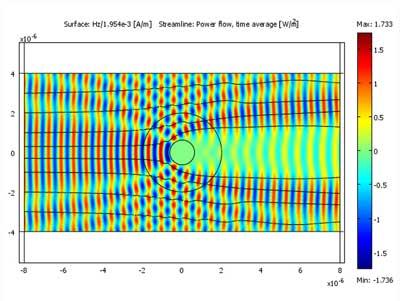
Normally, incident light waves on an object are absorbed or reflected, causing the object to appear visible. With the cloaking device active, light is 'deflected' around the object to make it appear as if it did not exist, rendering it invisible.
Cloaks with magical powers of invisibility appear from the earliest days of story-telling. Since the advent of modern Science fiction, many variations on the theme with proposed basis in reality have been imagined. Star Trek screenwriter Paul Schneider, inspired in part by the 1958 film Run Silent, Run Deep, and in part by The Enemy Below, which had beleased in 1957, imagined cloaking as a space-travel analog of a submarine submerging, and employed it in the 1966 Star Trek episode "Balance of Terror", in which he is introduced the Romulan species, whose space vessels employ cloaking devices extensively. (He likewise predicted, in the same episode, that invisibility, "selective bending of light" as described above, would have an enormous power requirement.) Another Star Trek screenwriter, D.C. Fontana, coined the term "cloaking device" for the 1968 episode "The Enterprise Incident", which also featured Romulans.
Star Trek placed a limit on use of this device: a space vessel cannot fire weapons, employ defensive shields, or operate transporters while cloaked;[4] thus it must "decloak" to fire—essentially like a submarine needing to "surface" in order to launch torpedoes.[5]
 Writers and game designers have since incorporated cloaking devices into many other science-fiction narratives, including Doctor Who, Star Wars, and Stargate.
From Wikipedia, the free encyclopedia